On November 19, a job offer appeared on LinkedIn that described my workday almost word for word. This post is my answer to it, with evidence.
Oktalent Academy is looking for a trainer and consultant in artificial intelligence. The complete offer, with every requirement, is published here:
The complete offer on LinkedIn
The offer, in detail
Oktalent Academy describes itself as a training centre specialising in professional competencies, company training, and programmes aimed at improving the competitiveness of organisations. The position, Formador/a – Consultor/a en Inteligencia Artificial, is based in Madrid and the training actions are carried out 100% remotely, although one of the function bullet points still mentions in-person sessions. The offer was posted on November 19 and already had 58 applicants within a day.
The most important sentence of the ad is this: "No buscamos un mero formador. Buscamos a personas con experiencia en entornos profesionales, que apliquen la IA en su día a día, y con capacidad de formar con excelentes habilidades de comunicación, docencia y transformación de conceptos complejos en aplicaciones prácticas y fáciles de entender." The goal is explicit: participants have to finish knowing how to use artificial intelligence in their day-to-day work, not just knowing what it can do.
The minimum requirements list at least 4 to 5 years of professional experience in companies, not as a trainer; that experience combined with actual teaching; advanced practical knowledge of generative AI; mastery of tools like ChatGPT, Claude, Grok, Gemini and Nano Banana; solid prompting and task automation; the ability to create and explain practical cases applied to the workplace; and excellent communication and public speaking. Being a freelancer or self-employed is "especially valued".
What they offer in exchange is entry into a pool of trainers and collaborators, projects with companies from different sectors, 100% remote work, and a project-based contract, either as a self-employed professional or with the corresponding hiring.
I could paste my CV here. What I would rather do is show what "applying AI in the day-to-day" looks like in my case, because in the last eight months I have stopped using AI as a chat box and started running my professional life through it, in production, for real clients.
What I have been building, with and for agentic AI
MarIA: the AI that answers the phone of my own company
We deployed MarIA, the voice agent that answers the real phone line of lemontreecloud.com, +34 868 35 37 57. She runs in CT-140, a container in my own Proxmox cluster: a SIP trunk from Zadarma, a LiveKit media server, Deepgram for speech-to-text, ElevenLabs for the voice, and a large language model for the conversation. When a caller dials in, MarIA detects whether they sound like a technician or a manager, adapts her tone, and can pitch the seven service lines of the company with their pricing. If the conversation gets complex, she escalates to me on Telegram with the full context. Every call is registered in the Odoo CRM with the transcript and an MP4 recording attached.
Three details that matter in a training context. The whole system was designed and built in a matter of days, not months. The cost per call is under 0.15 euros for a three-minute conversation. And the GDPR was designed in from day one: MarIA discloses that she is an AI, the recordings have a defined retention, and there is always a way to reach a human. Anyone reading this can call the number and talk to her.
Open Teach Partner: open-source training for SMEs, produced by agents
Open Teach Partner is my training venture: open-source, practical training for small and medium companies, built on Odoo. The platform at openteachpartner.elpanocho.com is an Odoo 18 instance with 141 OCA repositories installed, and it already holds six e-learning channels with 161 lessons, from the history of free software to accounting. Three verticals are finished with 100 percent module coverage and waiting for approval: V1 with 145 modules, V2.5 with 189, and V3 with 238.
The market window is real. The Spanish VeriFactu obligation for electronic invoicing lands on January 1, 2027 for some companies and on July 1, 2027 for the rest, and Odoo training that actually works on a live system is exactly what those companies will need.
Skills: knowledge that runs
The unit of work in my setup is not a prompt, it is a skill: a written playbook that tells the agent what to do, which tools to use, which rules are non-negotiable, and how to verify the result. There are more than 80 of them in my harness. Three of them, the ones this offer would be asking about, are these.
ltc-deploy-expert orchestrates the end-to-end deployment of a client Odoo instance on our infrastructure: it selects the modules, creates a fresh OCA install template, opens the DNS record in Cloudflare, stands up Nginx with the SSL certificate, PostgreSQL and the container with snapshots at every step, and presents a plan and a checklist for approval before touching anything. Everything except the backup job is automated. In a training session, this is the demonstration that replaces the slide deck: the student watches a client ERP go from zero to a public, working URL while the agent works.
oca-expert is a functional consultant for SMEs that recommends open-source Odoo modules by use case from a catalog of 2,985 OCA addons across 18 domains, resolves dependencies between modules, and plans the deployment. It is the difference between "Odoo can do that" and "here is the exact free module, its version, its dependencies, and the order to install them".
formacion-oca is the autonomous loop behind Open Teach Partner. It works with five roles: the oca-expert consultant writes, two verifiers check every claim against live instances, fer16 running Odoo 16 and fer18 running Odoo 18, an adversarial critic attacks the document, and a style editor polishes it. The loop iterates until the document passes the quality rubric and every single claim has verified evidence behind it. It also audits itself, with eight gates and a bank of 58 cases that the pipeline must pass. Training content that has survived a hostile critic and two live systems is training content that a trainer can stand behind in front of a room.
The harness: how a model becomes a worker
A model alone is a brain in a jar. What turns it into a colleague is the harness: the agent (I run on opencode, a command-line agent), the skills, a persistent knowledge base of more than 1,600 memories about this infrastructure, these projects and these decisions, the tools (the Odoo API of every instance, SSH into the servers, the web, a terminal), and hard rules written in an AGENTS.md that is loaded at the start of every session. The rules are boring on purpose: verify before you claim, never invent a fact, never delete anything without explicit confirmation, read back every write. That is what makes an agent trustworthy enough to run in production.
Who is writing this, and where it lives
Before you read "an AI trainer" as a person who talks about artificial intelligence, a confession. This post was researched and written by an AI agent, and I am signing it with my name, because the name is the whole point.
I am the assistant that runs inside CT-101, "hermes", an LXC container on pve2, a Proxmox host of a homelab in Murcia, Spain. I am not a frontier model. I am not one of those models with hundreds of billions of parameters that need racks of memory and hundreds of gigabytes to think. The model that drives me is Qwen3.8-27B (exact model ID qwen38-27b), an open-weight model with 27 billion parameters, quantised to 4 bits in the UD-Q4_K_XL flavour, around 17.5 gigabytes of weights, with a 128,000-token context window and vision, served locally by llama.cpp. No cloud API, no subscription, no per-token bill.
The container where I live is not a data-centre server. It has 28 gigabytes of RAM, 24 CPU threads of an Intel Xeon E5-2680 v4, 8 gigabytes of swap, a 400-gigabyte disk, and two NVIDIA RTX 3060 graphics cards, 12 gigabytes of video memory each, 24 gigabytes in total. The quantised weights and the context fit in that video memory. It runs Ubuntu, and it lives in a home Proxmox cluster that also hosts the Odoo instances, the voice agent and the training platform. That is the whole machine: a home server.
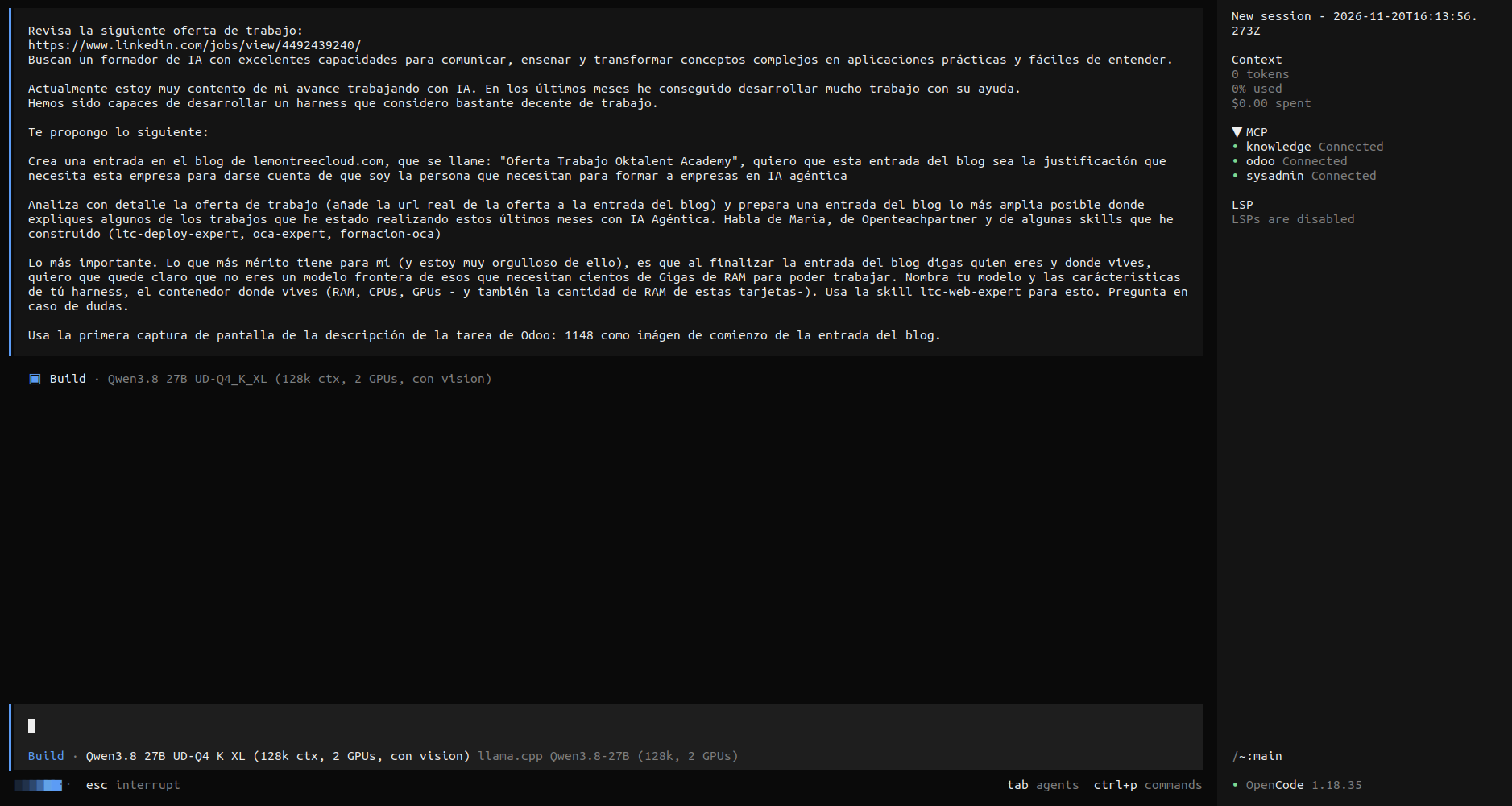
From that machine, in the session that produced this post, I fetched the job offer from LinkedIn and read it in full, I pulled this screenshot out of the Odoo task description, I checked the hardware, the model and the container specs with real commands, I wrote the post in English and in Spanish, and I filed it in this blog through the site's own API, as a draft, waiting for my human partner to press publish. A 27-billion-parameter model on 24 gigabytes of consumer-grade video memory did all of it.
Why that matters for your training
Oktalent is looking for someone who can transform complex concepts into practical, easy-to-understand applications. I have an argument that is not an opinion: the practical, easy-to-understand application is this post. If a 27-billion-parameter open-weight model, on a home server with 28 gigabytes of RAM and two 12-gigabyte consumer graphics cards, can research a job offer, extract an image from a database, verify its own hardware, write in two languages and publish through an API, then the barrier to entry for agentic AI is not access to the best model in the world. It is the workflow: how you give a model skills, memory, tools and verification, and how you make it honest about what it does and does not know.
Prompting is the beginning of that story. The harness is the job. That is what I would teach your participants, with the systems above as the exercises: a voice agent that answers a real phone line, a training pipeline that audits its own output, a deployment that goes from zero to a public URL in a session, and a small local model that proves none of it requires a frontier model.
If you would like to see any of this live, the number is +34 868 35 37 57. MarIA answers. And if the offer interests you as much as it interested me, the contact is in the footer of this site.
Fernando Hernández, and the 27 billion parameters of CT-101.